

Quick Summary: Which Format Do You Need?
- 16-Line Pakistani Format: The undisputed national standard across Pakistani Madrassas and schools for Hifz (memorization) and daily recitation. Every page starts and ends with a complete Ayah.
- 15-Line Saudi / Middle Eastern Format: Preferred by students memorizing in Saudi Arabia, Gulf countries, or international Quran academies using the standard Madinah Mus’haf page layout.
- Muarra (10, 11, 12, or 13 Lines): Bold, extra-large Nastaliq calligraphy with generous spacing between words. Ideal for senior citizens, beginners, children learning Nazra, and low-vision readers.
1. The 16-Line Quran: Pakistan’s Hifz & Madrassa Standard
In Pakistan, India, Bangladesh, and the broader South Asian diaspora, the 16-Line Quran Majeed is the cornerstone of Islamic education. If your child is enrolled in a Madrassa Hifz program or school Nazra classes, 99% of instructors will specifically instruct you to buy a 16-line edition.
Why 16 Lines for Memorization?
The genius of the 16-line format lies in its photographic memorization mechanics:
- Ayah-End Rule (آیت ختم ہونا): In standard 16-line Pakistani calligraphy, every single page begins at the start of an Ayah and ends cleanly at the end of an Ayah. A verse never spills over into the first line of the next page. This allows the memorizer (Hafiz) to imprint the complete page visual into memory like a photograph.
- Predictable Para Division: Exactly 548 to 550 pages make up the entire 30 Paras, averaging roughly 18 to 20 pages per Juz (Jepara). This makes daily recitation targets (e.g., one quarter or half Para daily) perfectly measurable.
- Indo-Pak Calligraphy: Written in the bold, rounded, non-overlapping Nastaliq style native to Pakistan, featuring distinct diacritical marks (A’raab) and clear Waqf (stopping) symbols.
Both our classic 76-W Offset Edition and our certified 16-Line Color-Coded Tajweed Editions share the exact same 548-page grid, ensuring page-for-page consistency across classroom instruction and home revision.
2. The 15-Line Quran: The Saudi / International Mus’haf
The 15-Line Quran is the standard format popularized worldwide by the King Fahd Complex for the Printing of the Holy Quran in Madinah Munawwarah.
Key Differences Between 15-Line and 16-Line
- Page Count: A standard 15-line Mus’haf spans exactly 604 pages (roughly 20 pages per Juz), whereas a 16-line edition spans approximately 548 pages.
- Ayah Flow: Like the 16-line, standard 15-line editions also feature the Ayah-end rule on every page. However, because each page has one less line, the text is redistributed across 56 additional pages.
- Target Audience: Highly recommended if your child is attending an online Quran academy based in Saudi Arabia, the UK, the US, or the UAE that teaches using the Madinah Mus’haf layout. It is also common for South Asian translations where explanatory foot-margins require a 15-line text block (such as our 64-GOL Maulana Ashraf Ali Thanvi Translation).
3. Muarra & Bold Font Editions: 10, 11, 12, and 13 Lines
The word Muarra (معریٰ) refers to large-font Quran editions specifically designed with fewer lines per page to maximize readability.
Who Benefits Most from Muarra?
- Senior Citizens & Elders: As vision weakens with age, reading compact 15 or 16-line text can cause severe eye fatigue. A 10-line or 11-line edition features letters more than twice the size of standard editions, allowing effortless recitation under domestic lighting.
- Children Starting Nazra: Young learners transitioning from the Qaida to the Holy Quran often get overwhelmed by crowded pages. Large, bold script helps them distinguish individual Haroof and Tashkeel without confusion.
- Daily Tilawat for Relaxation: Readers who recite multiple Paras daily find that large script significantly reduces eye strain.
Explore our collection of 10-Line Rexine Purse (10-D) and 11-Line Large Format (101-OS).
Comprehensive Format Comparison Table
Use this comparison table to quickly evaluate line counts, physical dimensions, script styles, and best use cases:
| Format | Lines / Page | Typical Page Count | Standard Sizes (Inches) | Best Suited For |
|---|---|---|---|---|
| 16-Line Hifz Standard | 16 Lines | ~548 pages | 5.75″ x 9″ (Standard) 7.5″ x 10″ (Large) |
Pakistani Madrassa students, Hifz programs, and daily household recitation. |
| 16-Line Tajweedi | 16 Lines | ~548 pages | 5.75″ x 9″ (Standard) 5″ x 7.5″ (Compact) |
Adults and students learning correct pronunciation (Madd, Ghunnah, Ikhfa) with certified color coding. |
| 15-Line Mus’haf | 15 Lines | 604 pages | 7.5″ x 11.5″ (Large Desk) 5.75″ x 9″ (Standard) |
Saudi / Gulf curriculum students, overseas academies, and line-by-line Urdu translations. |
| 12 / 13-Line Medium | 12 to 13 Lines | ~850 to 950 pages | 7.5″ x 10″ 7.5″ x 10.5″ |
Intermediate readers wanting larger text than 16-line without the bulk of a 10-line. |
| 10 / 11-Line Muarra | 10 to 11 Lines | ~960 to 1440 pages | 7.5″ x 10″ (Desk) 3.75″ x 5.75″ (Purse) |
Elderly parents, senior citizens, children beginning Nazra, and low-vision reciters. |
Understanding Standard Quran Dimensions (Sizes in Inches)
In Urdu Bazaar publishing terminology, Quran sizes are measured in inches:
- Pocket / Travel Size (3.75″ x 5.75″): Compact enough for a handbag, glove compartment, or briefcase. Usually bound in flexible Rexine with a zipper or flap closure.
- Standard Desk / Madrassa Size (5.75″ x 9.0″): The most popular size in Pakistan. Balances large, clear calligraphy with comfortable handheld weight. Fits standard wooden rehals.
- Large Senior Desk Size (7.5″ x 10.0″ and 7.5″ x 11.5″): Designed primarily for home rehal stands and mosques. The generous page width allows jumbo Arabic letters and wide margins for easy reading.
Featured Editions Available Online from Alif Zafar Sons

Quran Majeed 16 Lines (76-W)
5.75″ x 9″ • Imported Offset Paper 60gsm • Durable Hard Binding

Tajweedi with Rehal Box (S-23-GR)
5.75″ x 9″ • 7-Color Rules • Golden Rexine + Built-in Rehal Gift Box
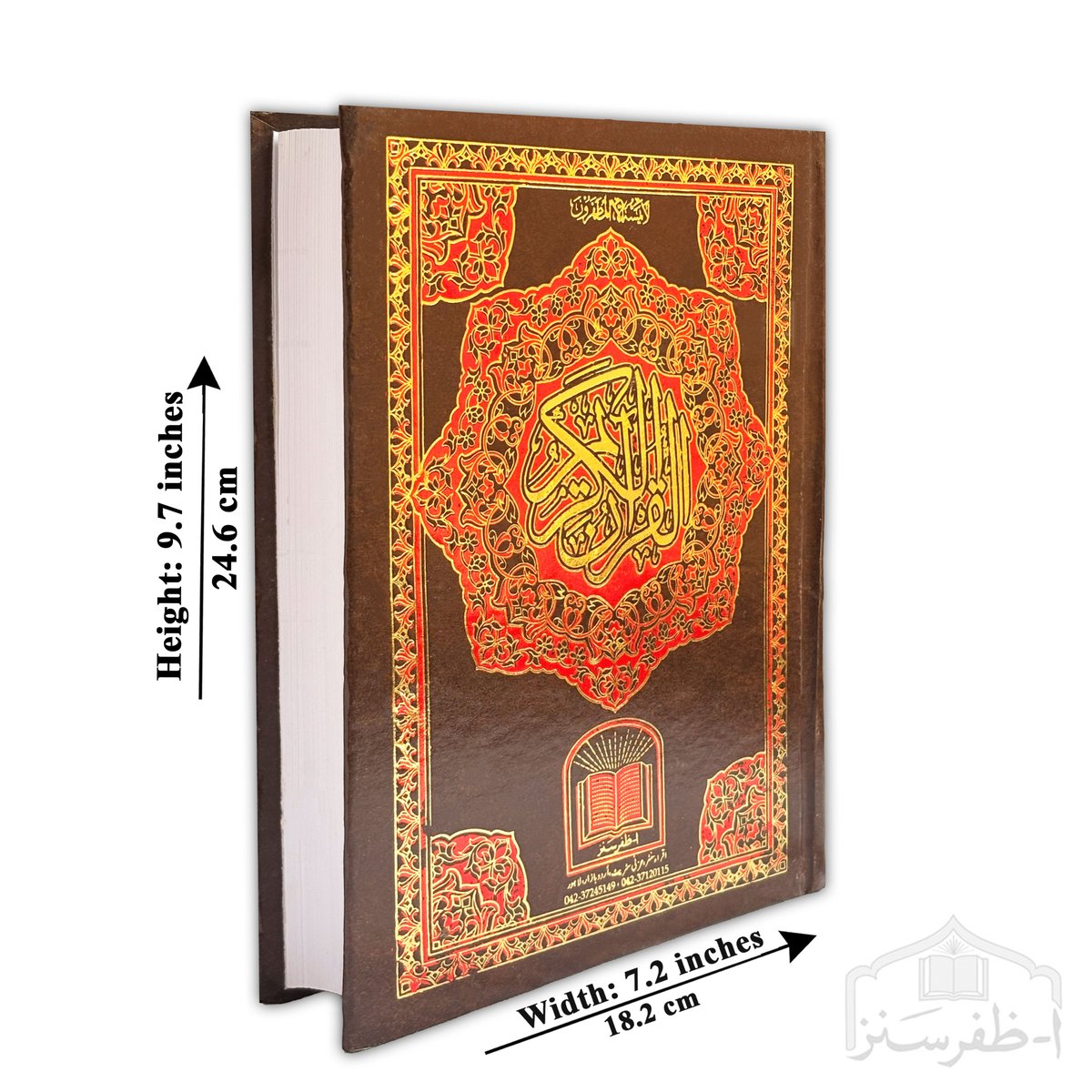
Quran Majeed 11 Lines (101-OS)
7.5″ x 10″ Large Desk • 2-Color Print • Ideal for Elderly & Beginners
Madrassa Administrators & Waqf Bulk Donors
Ordering in bulk for a Madrassa, school, mosque, or overseas Waqf (Isal-e-Sawab) sponsorship? Alif Zafar Sons packs standardized 15-line and 16-line editions in heavy-duty export master cartons (typically 66 copies per carton) with direct goods transport dispatch from Urdu Bazaar across Pakistan.
👉 Visit our Dedicated Wholesale & Bulk Supply Page or connect directly on WhatsApp at 0311 1132320 for custom carton quotations and bilty tracking.
